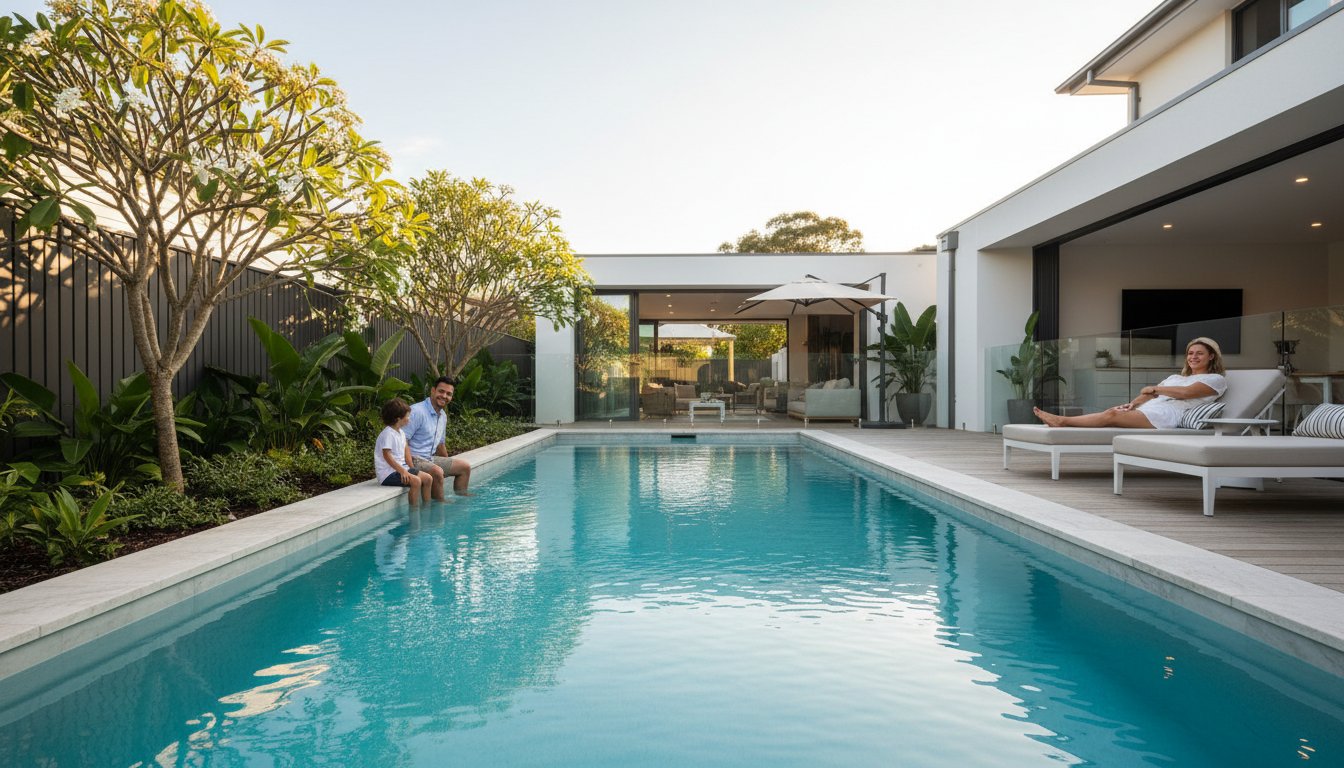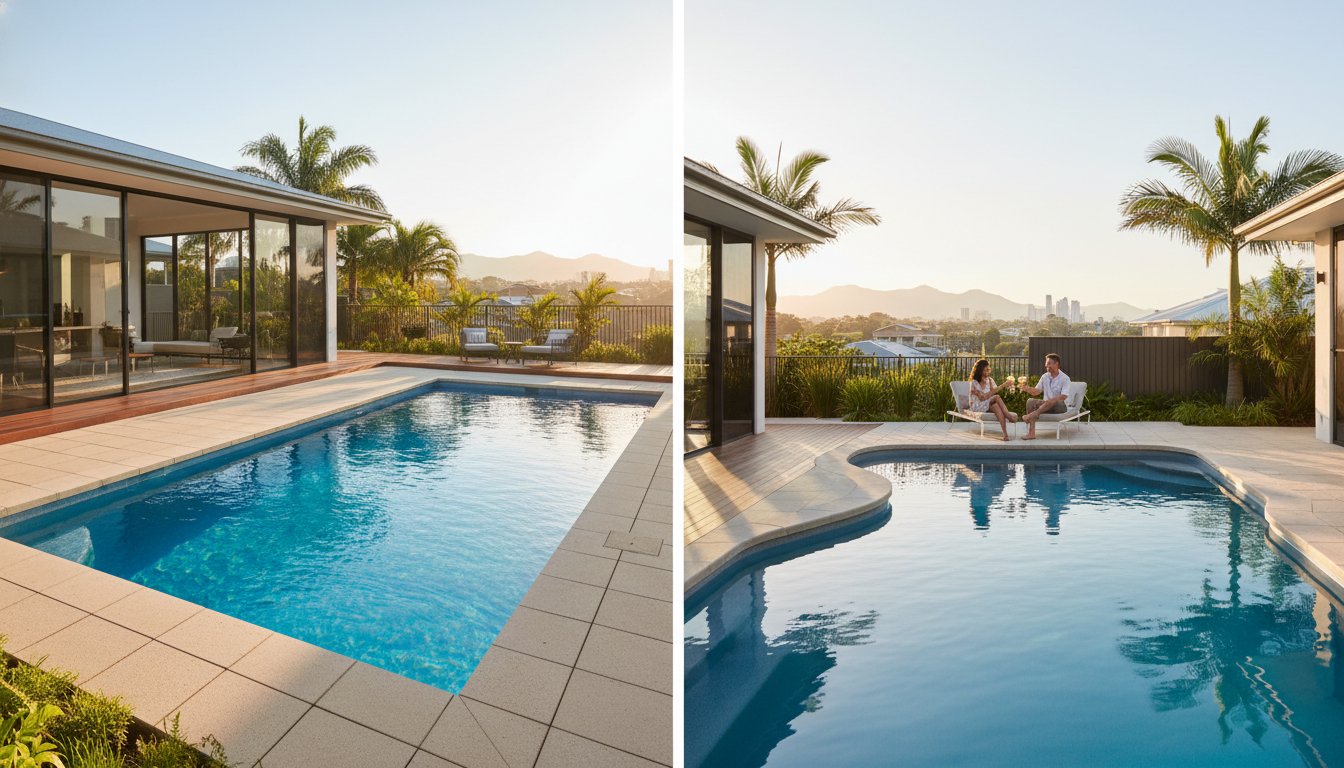

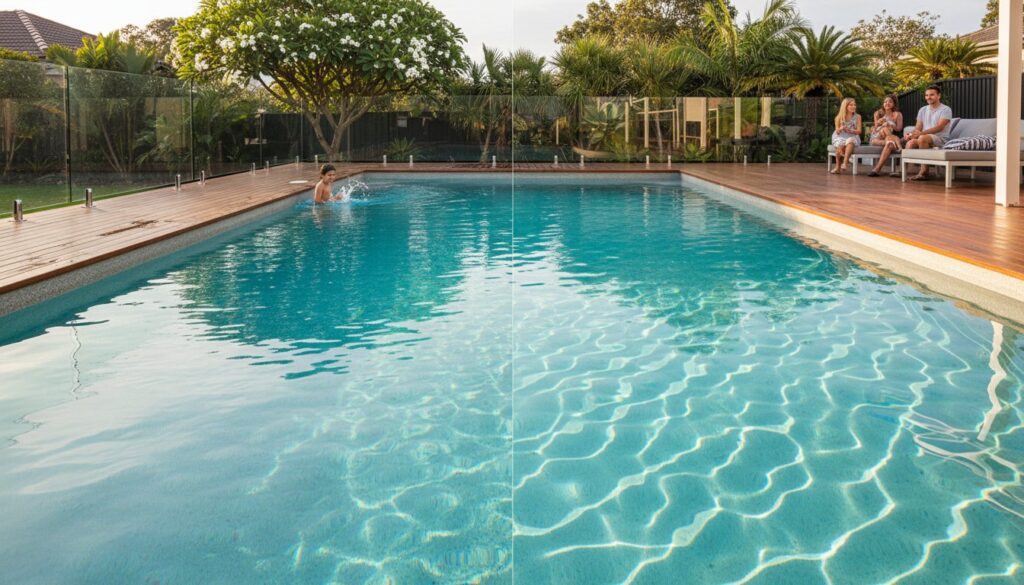
Last January, a family in Bulimba discovered that their A$3,000 epoxy refresh had started chalking and clouding their water just 14 months after the job was finished. It’s a frustrating reality in our Queensland climate, where high UV levels and humidity quickly expose the limitations of a thin coat of paint. When you compare pool resurfacing vs repainting, you’re really choosing between a temporary cosmetic fix and a long-term investment in your home’s integrity. We understand you want a backyard that’s easy to maintain, beautiful to look at, and safe for bare feet.
Drawing on forty years of local craftsmanship, we’ll show you how a marble resurface can last five times longer than paint while adding up to A$20,000 in property value. You’ll discover the critical differences between a short-term fix and a durable finish designed to protect your quality concrete pools for 15 years or more. This guide explains the technical durability, maintenance requirements, and aesthetic benefits of each option to ensure your renovation is a seamless and rewarding experience.
Key Takeaways
- Understand the fundamental difference between a topical coating and a complete structural restoration to ensure your pool remains a lasting asset for your home.
- Evaluate the long-term ROI of pool resurfacing vs repainting by comparing how each method withstands Brisbane’s intense UV radiation and moisture levels over a ten-year horizon.
- Discover why “breathable” cementitious finishes prevent the osmotic blistering and bubbling common with epoxy paints, protecting the structural integrity of your concrete shell.
- Learn how to identify critical warning signs, such as “drummy” hollow-sounding areas, that signal your pool requires a professional remarble rather than a temporary cosmetic fix.
- Leverage over five decades of SE Queensland craftsmanship to understand why a smooth crushed marble finish provides the most enduring and seamless result for your family’s investment.
Pool Resurfacing vs. Repainting: Defining the Choice for Brisbane Homeowners
For Brisbane families, the backyard pool is the heart of the home. As we look toward 2026, the harsh South East Queensland sun continues to test the limits of every swimming pool construction project in the region. Deciding between pool resurfacing vs repainting requires an understanding of both chemistry and craftsmanship. While a fresh coat of paint offers a quick, vibrant update, it remains a topical solution. Professional resurfacing involves a complete restoration of the cementitious layer. This distinction is the difference between a temporary facelift and a twenty-year investment in your property’s value.
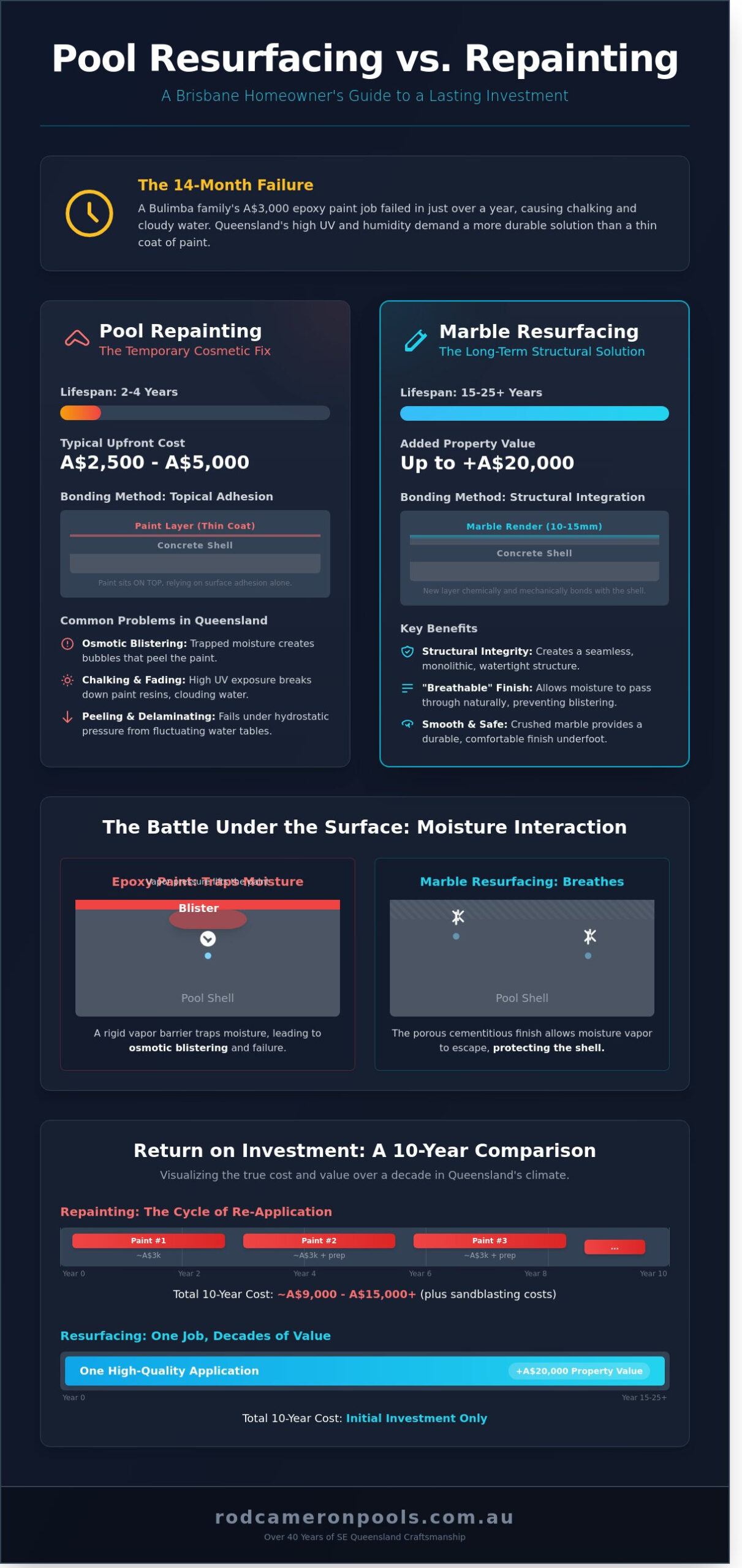
The primary motivator for painting is usually the immediate cost-saving. A basic paint job might cost between A$2,500 and A$5,000. In contrast, homeowners who choose resurfacing are looking for longevity and structural integrity. Our local climate makes this choice critical. The intense UV levels and humidity in Brisbane can cause inferior surfaces to degrade rapidly, leading to leaks or shell damage if the protective barrier fails. We believe in doing the job once and doing it right.
What is Pool Repainting?
Pool painting involves applying a topical coating to the existing surface. The three most common types are epoxy, chlorinated rubber, and water-based acrylic. While these products provide a bright finish initially, they don’t bond structurally to the concrete. In high-UV regions like the Gold Coast, you can expect a lifespan of only 2 to 4 years before the finish begins to chalk or peel. Many people are drawn to the DIY appeal of painting to save money. Unfortunately, this often leads to professional intervention later when the old paint must be sandblasted off at a significant expense.
What is Professional Pool Resurfacing?
Professional resurfacing is a meticulous process that involves removing the old, worn-out finish and applying a new layer of remarbling. This finish consists of smooth crushed marble mixed with high-grade white cement. Unlike paint, this material creates a permanent structural bond with the concrete shell. This ensures the surface remains watertight and smooth underfoot for decades. A high-quality marble resurface typically has a life expectancy of 15 to 25 years. At Rod Cameron Pools, we’ve spent 40 years perfecting this technique to ensure every pool we touch remains a seamless, enduring part of the home.
The Technical Reality: How Each Method Interacts with Your Pool Shell
Understanding the technical nuances of pool resurfacing vs repainting is essential for Brisbane homeowners who value longevity and structural integrity. A cementitious marble finish acts as a breathable skin for your pool, allowing moisture to move naturally through the concrete matrix without compromising the surface. Conversely, epoxy paints create a rigid vapor barrier that traps moisture within the shell. In the 30-degree heat of a typical Brisbane summer, moisture trapped behind this barrier often leads to osmotic blistering. These unsightly bubbles occur when water vapor exerts pressure against the paint film, causing it to lift, stretch, and eventually fail. While painting is often marketed as a quick fix, professional resurfacing requires the meticulous skill of a master tradesman to chip away degraded material and apply a new 10mm to 15mm layer of high-grade marble render.
The Bonding Process
A professional resurfacing project creates a mechanical and chemical bond with the existing substrate that paint simply cannot match. We use specialized bonding agents to ensure the new marble finish integrates with the concrete shell, creating a seamless, monolithic structure that stands the test of time. Paint relies solely on surface adhesion; it sits on top of the concrete like a thin laminate. Because the SE QLD water table can fluctuate by up to 1.5 meters during heavy rain events, hydrostatic pressure often pushes against the pool shell from the outside. While a marble finish remains stable under this pressure, paint is prone to peeling or delaminating within just 24 months of application. Our team adheres to strict pool industry standards to ensure every surface is prepared to withstand these specific local conditions.
Chemical Resistance and Water Balance
The chemistry of your pool water is a delicate balance that directly impacts the lifespan of your interior finish. Marble finishes are naturally inert and resist the corrosive effects of salt and chlorine, maintaining their texture for decades. Paint resins are organic compounds that inevitably break down under constant UV exposure and chemical sanitization. This leads to a phenomenon known as chalking. Chalking is the breakdown of paint resins into a powdery residue due to UV and chemical exposure. Over a 5-year period, a painted surface can lose up to 40% of its thickness through this degradation, leaving the concrete shell vulnerable. Resurfacing allows us to restore, protect, and beautify the pool while addressing deeper issues like concrete cancer or structural cracking. If you’re looking to restore your pool’s integrity, choosing a finish that works in harmony with the concrete is the only way to guarantee a stress-free result.
Durability and ROI: A 10-Year Comparison in the Queensland Climate
Deciding between pool resurfacing vs repainting requires looking far beyond the initial quote. In Southeast Queensland, our 300 days of annual sunshine act as a relentless testing ground for pool finishes. While a fresh coat of paint looks brilliant for the first summer, the brutal UV index in Brisbane quickly exposes the limitations of topical coatings. We’ve spent 40 years watching how different materials age in this climate, and the long-term data consistently favors a structural resurface.
The 10-Year Cost Breakdown
Painting a standard 8x4m concrete pool in Brisbane typically costs between A$3,200 and A$4,800. However, paint is a sacrificial layer. In our experience, a painted surface in Queensland requires a full strip and re-application every three to four years to prevent chalking. Over a decade, you’ll likely pay for three separate painting projects, totaling upwards of A$13,000. This doesn’t account for the rising costs of labor and materials by 2026.
Contrast this with a Rod Cameron marble resurface. A one-time investment of approximately A$9,500 to A$14,000 provides a finish that lasts 15 to 20 years. We offer a stress-free, fixed-price renovation that eliminates the cycle of repeated repairs. You pay once, and the job is done for the next two decades. This stability is why we view resurfacing as a genuine capital improvement rather than a temporary patch.
Maintenance and Lifestyle Impact
The “hidden costs” of painting often surface in your monthly chemical bill. Brisbane’s intense UV radiation causes epoxy paints to oxidize and “chalk” within 24 months. This powder enters your water, clouding the clarity and forcing you to use more flocculants and pH adjusters. Maintaining long-term durability and compliance with safety standards is much simpler with a marble finish, which remains chemically inert and won’t flake into your filtration system.
- Surface Texture: Smooth marble finishes are gentle on skin, whereas aged paint becomes abrasive or peels in sharp flakes.
- Algae Resistance: Painted surfaces develop microscopic cracks that harbor black spot algae; marble finishes are polished to a density that resists organic growth.
- Property Value: In the Brisbane real estate market, a resurfaced pool adds roughly 5% to 8% to a home’s resale value, while a painted pool is often viewed by inspectors as a maintenance liability.
A pool should be a place for family memories, not a source of weekend labor. By choosing a permanent resurfacing solution, you ensure your pool is always ready for a swim, regardless of how many 40-degree days the Brisbane summer throws your way.
Signs Your Pool Needs More Than a Coat of Paint
Sometimes a fresh look requires more than a bucket of epoxy. While the debate of pool resurfacing vs repainting often feels like a simple budget decision, the physical state of your concrete shell usually dictates the correct path forward. If the underlying structure is compromised, applying paint is like trying to fix a cracked foundation with wallpaper. Our team has seen hundreds of Brisbane pools where a “quick fix” paint job failed within 12 months because the homeowner overlooked critical warning signs that signaled deeper distress.
A coat of paint cannot bridge structural gaps or bond to a surface that is already falling away. We take pride in our 40-year heritage of building quality concrete pools, and that experience has taught us that shortcuts always cost more in the long run. Identifying these red flags early protects your investment and ensures your backyard remains a place for family memories rather than a construction site.
The “Drummy” Test
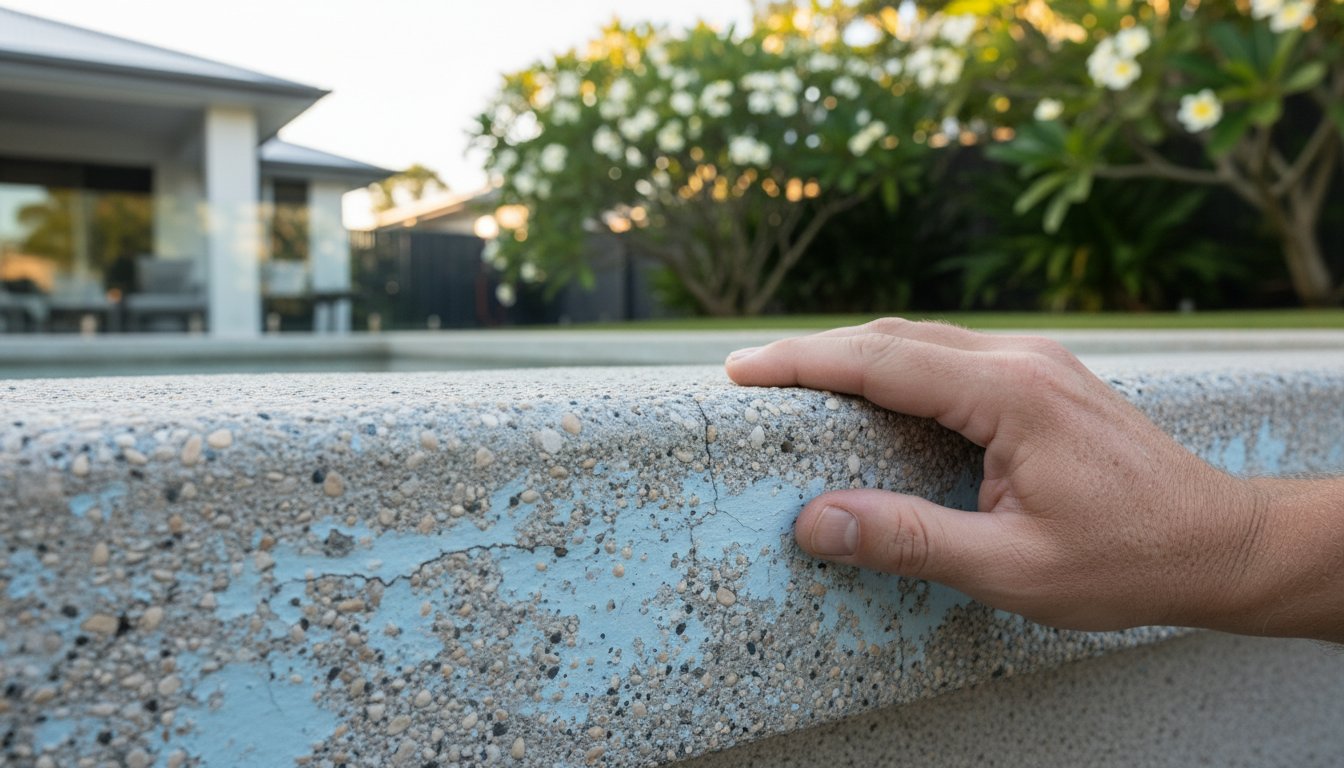
You can check the integrity of your pool’s bond through a simple “drummy” test. Walk through your empty pool or use a telescopic pole to gently tap across the floor and walls. A solid, healthy surface produces a sharp “click,” whereas a hollow, drum-like sound reveals delamination where the finish has detached from the concrete shell. Painting over these voids is a waste of resources. The new layer will simply peel away as the air pockets expand in the 30-degree Brisbane heat. For any pool over 15 years old, a meticulous professional assessment is essential to ensure the shell remains sound before you invest in any aesthetic updates.
Visible Surface Failure
Surface degradation often goes deeper than the eye can see. While simple staining might be manageable, deep-seated mineral scaling or “black spot” algae indicates a porous, failing surface. This stubborn algae thrives in the microscopic pits of aged, degraded plaster, making it nearly impossible to eradicate with chemicals alone. You should also watch for rust spots. These small brown marks often signal that the internal steel reinforcement is oxidizing, a condition known as concrete cancer that can compromise the entire structure. Surface cracks are often symptoms of deeper structural shifts in Brisbane’s reactive clay soils, which can move by up to 50mm during extreme weather cycles.
Why Rod Cameron Pools Recommends Smooth Marble Resurfacing
Since our founding in 1968, Rod Cameron Pools has remained a fixture of the Southeast Queensland landscape. We’ve spent 58 years refining our craft across thousands of backyards. When homeowners weigh up the benefits of pool resurfacing vs repainting, we consistently guide them toward smooth crushed marble. This finish requires a level of technical mastery that few modern contractors possess. It isn’t just about aesthetics; it’s about the structural integrity of your investment. Our team understands the chemistry of Brisbane water and the intensity of the local sun, ensuring your pool remains a centerpiece for decades.
Transparency is the cornerstone of our family-owned business. We provide a Fixed-Price promise on every renovation. This means the quote you receive is the final figure. We don’t believe in hidden extras or mid-project surprises that inflate your budget. Our teams are also experts at managing the logistical hurdles of older Brisbane suburbs. Whether your property has narrow side-access in Paddington or steep, difficult terrain in Ashgrove, we have the specialized equipment and experience to deliver a seamless result without disrupting your daily life.
The Rod Cameron Remarbling Process
Every project follows a methodical, multi-stage path to ensure a bond that lasts. We begin with a high-pressure clean and a thorough structural assessment to identify any underlying issues. Our master tradesmen then hand-trowel the crushed marble finish to achieve a silky, non-abrasive texture that’s gentle on skin. This meticulous approach serves both residential backyards and large-scale commercial facilities from the Gold Coast to the Sunshine Coast. We focus on three core pillars: precision, durability, and craftsmanship.
Investing in a Timeless Finish
A quick fix like pool painting often fails within 24 to 36 months as the chemicals and UV rays degrade the bond. In contrast, a marble resurface is a lifelong transformation. It offers a bespoke, sophisticated look that adds genuine market value to your property. We aim to make the entire renovation stress-free and rewarding. You can Book a Fixed-Price Assessment for your Brisbane Pool to receive an honest evaluation from our seasoned experts. Let our family help yours create an enduring space for memories, laughter, and relaxation.
Secure the Longevity of Your Brisbane Oasis
Choosing the right finish for your backyard is about more than just aesthetics; it’s about protecting your home’s value for the next two decades. While a coat of paint might offer a temporary refresh for 24 months, the technical reality of the Queensland climate demands a more robust solution. Our 10-year comparison data shows that smooth marble resurfacing provides a significantly higher ROI by eliminating the need for biennial maintenance. When you weigh up pool resurfacing vs repainting, the choice for a lasting, seamless finish becomes clear for those who value craftsmanship over a quick fix.
Since 1968, Rod Cameron Pools has helped families design, construct, and maintain quality concrete pools across Brisbane. We specialize in meticulous marble finishes that feel as good as they look, ensuring your swim is always comfortable and your pool shell remains structurally sound. Whether you manage a commercial facility or a private residence, our team provides the certainty of fixed-price quotes to keep your project stress-free. Transform your pool with a fixed-price resurfacing quote from Rod Cameron Pools and enjoy the peace of mind that comes with over 55 years of local expertise. We look forward to helping you restore the heart of your home.
Frequently Asked Questions
How long does pool paint actually last in Brisbane?
In the harsh Brisbane climate, pool paint typically lasts between 2 and 4 years before it begins to chalk or peel. The 300 days of intense annual sunshine and UV ratings that frequently exceed 11 during summer months cause epoxy and chlorinated rubber coatings to degrade rapidly. This short lifespan often leads to a cycle of frequent maintenance that can disrupt your family’s summer enjoyment and lifestyle.
Can I resurface a pool that has already been painted?
You can certainly resurface a pool that has been previously painted, provided the old coating is entirely removed first. Our team uses abrasive blasting to strip 100% of the existing paint from the concrete shell to ensure the new finish bonds correctly. This meticulous preparation is vital for the integrity of your quality concrete pools, preventing the new surface from delaminating or bubbling over time.
Is marble resurfacing much more expensive than painting?
While a professional paint job might cost between A$2,500 and A$4,000, a premium marble resurfacing typically starts at A$6,500 for a standard family pool. However, when evaluating pool resurfacing vs repainting, the marble finish offers a 15 to 20 year lifespan compared to the 3 year average for paint. This makes marble a more cost-effective investment that provides enduring value, beauty, and a bespoke aesthetic for your backyard.
What are the main risks of DIY pool painting?
The primary risks of DIY painting include poor bond strength and chemical blistering, which can ruin the finish in less than 6 months. Industry data shows that 65% of DIY failures occur because the concrete wasn’t tested for moisture levels below 5% before application. Without professional equipment and 40 years of expertise, you risk creating a patchy, chalky surface that requires expensive remedial work to fix properly.
How long does a professional pool resurfacing take to complete?
A professional resurfacing project for a standard 8×4 metre pool typically takes between 7 and 10 working days to complete. This timeframe includes the initial drainage, surface preparation, application of the new finish, and the essential curing period. When you choose pool resurfacing vs repainting, we manage every stage of the process to ensure a seamless transition, allowing your family to return to the water with minimal disruption.
Will resurfacing my pool increase my home value in the Gold Coast?
Resurfacing your pool can increase your Gold Coast property value by 5% to 10% based on 2024 market trends. A pristine, modern finish suggests a well-maintained home, often adding between A$30,000 and A$50,000 to the final sale price in suburbs like Broadbeach or Burleigh. It transforms a potential liability into a luxurious asset that attracts buyers looking for a move-in-ready lifestyle and enduring quality.
Why do you recommend smooth marble over pebblecrete finishes?
We recommend smooth marble finishes because they offer a sophisticated texture that is 100% gentler on skin compared to traditional 1-2mm pebblecrete. This non-porous surface helps reduce algae growth by up to 40%, making your water chemistry easier to manage and maintain. Our clients appreciate the blend of comfort, durability, and timeless elegance that only a meticulously applied marble finish can provide for quality concrete pools.
What happens if I ignore a peeling pool surface?
Ignoring a peeling surface allows water to penetrate the concrete shell, which can lead to structural concrete cancer and black spot algae infestations. If left unaddressed for more than 12 months, the cost of structural repairs can quickly exceed A$12,000. Addressing the issue early protects the core integrity of your pool and prevents a simple cosmetic update from turning into a major, stressful construction project.