
The first 28 days of your pool’s new life are a “chemical marriage” that determines whether your surface lasts five years or over twenty. You’ve just invested in a beautiful, smooth crushed marble finish, and it’s natural to feel some trepidation about the technical steps required to protect it. Between the physical effort of daily brushing and the sea of contradictory chemical advice found online, the fear of permanently staining your pristine investment can be quite overwhelming for any homeowner.
Caring for a newly resurfaced pool doesn’t have to be a source of stress when you have a professional roadmap to follow. This expert-led guide provides the exact steps needed for curing, brushing, and balancing your water to ensure a finish that remains durable, smooth, and vibrant for decades. We’ll walk you through a simple, day-by-day maintenance schedule that turns a complex technical process into a manageable and rewarding transition for your home. By following these proven standards, you’ll secure the longevity of your project and enjoy the crystal-clear sanctuary you’ve always envisioned.
Key Takeaways
- Learn why you must keep the water running continuously until it reaches the skimmer to prevent permanent tide marks on your new marble finish.
- Discover the essential twice-daily brushing routine for caring for a newly resurfaced pool, which is vital for managing plaster dust and ensuring a smooth surface.
- Understand which common equipment, such as salt chlorinators and robotic cleaners, must remain switched off for the first 30 days to avoid permanent damage.
- Identify the difference between normal curing variations and early warning signs to maintain a finish that remains durable for over twenty years.
- Master the chemistry balancing act required during the first month to protect your investment and ensure a frictionless transition to daily enjoyment.
The Critical First 24 Hours: Managing the Fill Day
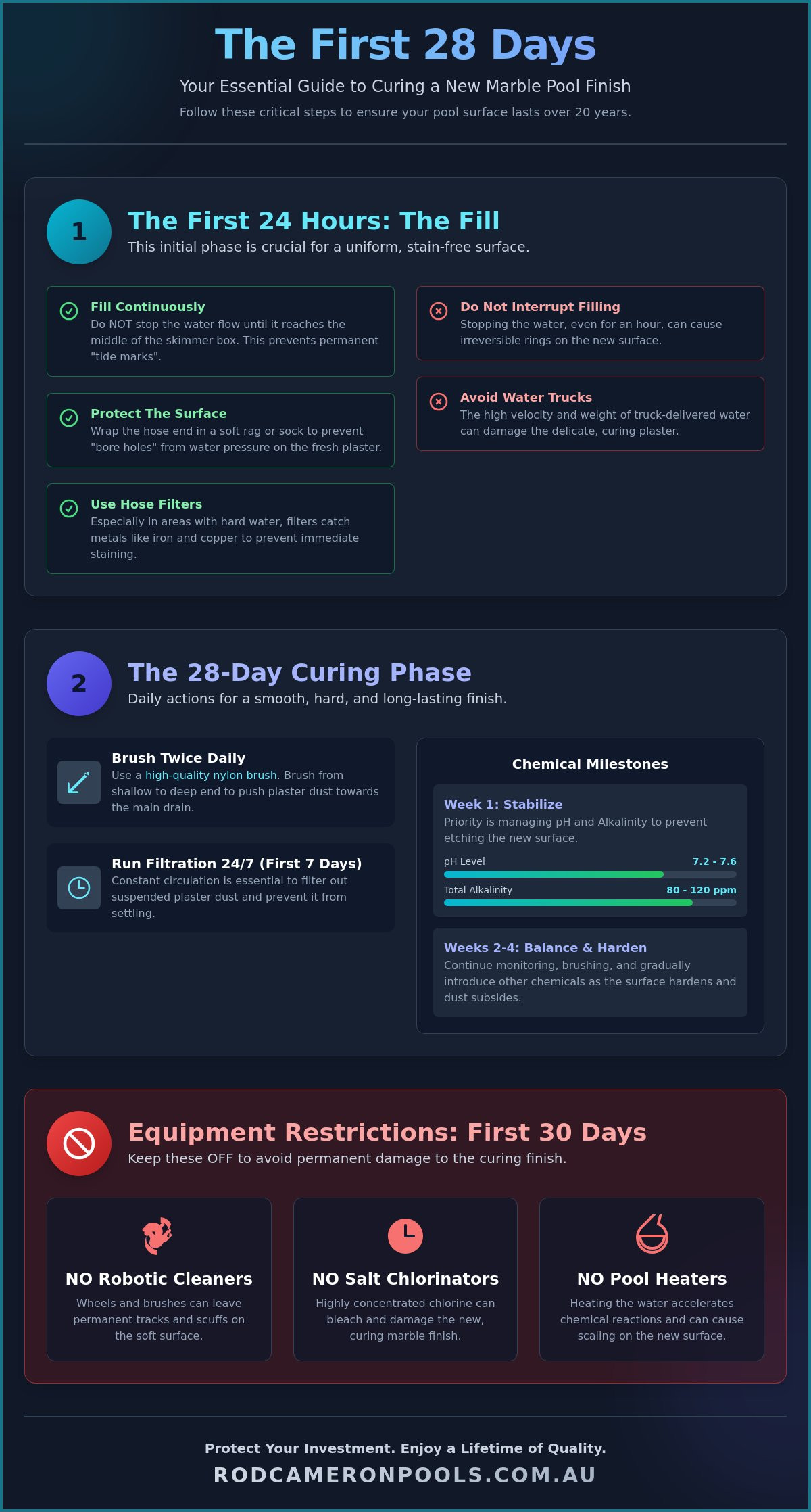
The moment our team finishes the hand-troweled application of your smooth marble finish, a silent but vital countdown begins. Caring for a newly resurfaced pool starts with the very first drop of water, as this initial fill is what sets the stage for a durable, lifelong bond. You must never stop the water flow until it reaches the middle of the skimmer box. If the water stops for even an hour, it creates “tide marks” or permanent rings that are nearly impossible to remove. These unsightly lines occur because the fresh pool plaster is still in its early hydration stage, and an interrupted fill causes uneven drying across the surface.
In the intense Brisbane sun, an empty pool shell is particularly vulnerable. We recommend starting the fill immediately to shield the material from heat and prevent it from drying out too quickly. To protect the soft, new surface from the force of the water, always wrap the end of your hose in a soft rag or a clean sock. This simple step prevents high-pressure “bore holes” or erosion marks from forming while the plaster is still pliable. When caring for a newly resurfaced pool, the goal is a seamless, uniform hydration of the entire shell.
Hose Placement and Water Flow
Position your hose at the deepest point of the pool floor to allow the water to rise steadily. For many large SE Queensland family pools, using two or even three hoses is a wise strategy to speed up the process. We strongly advise using hose filters, especially in areas with high mineral content in the local tap water. These filters catch metals like iron or copper before they enter your pool, which protects your pristine marble finish from immediate metallic staining or discoloration.
Temperature and Evaporation Risks
During a Gold Coast summer heatwave, evaporation can fight against your progress and cause the upper sections of the plaster to dry faster than the base. While it is tempting to call a water truck to finish the job quickly, we generally advise against it unless we have specifically coordinated the delivery. The sheer weight and velocity of truck-delivered water can damage the delicate surface. If your water supply is interrupted by a local utility issue, keep the surface damp with a light mist from a garden hose, but don’t allow puddles to form at the bottom. This keeps the material cool and prevents premature cracking until the main fill can resume.
The 28-Day Curing Phase: Brushing and Chemistry
Once the water reaches the middle of the skimmer and the initial fill is complete, the focus shifts to the chemical and physical maturation of the surface. This 28-day window is a critical period where the finish achieves its final hardness, aesthetic depth, and structural integrity. Caring for a newly resurfaced pool during this time requires a steadfast commitment to the “Twice-Daily” rule, a practice that ensures the finish remains as smooth as the day it was applied. This process involves more than just keeping the water clear; it’s about managing the natural release of “plaster dust,” or calcium carbonate, which occurs as the marble finish cures underwater.
To keep this dust from settling and hardening into a rough, sandpaper-like scale, your filtration pump must run 24 hours a day for the first seven days. Constant circulation ensures that suspended particles are pulled into the filter rather than resting on the floor. This active management of the curing cycle is what separates a standard renovation from a professional pool restoration that stands the test of time. By the end of the first month, the transition from aggressive start-up chemistry to a steady maintenance routine will be complete, leaving you with a stable and resilient aquatic environment.
The Brushing Technique
For a smooth marble finish, always use a high-quality nylon brush. Avoid stainless steel bristles, as they are far too abrasive for a fresh surface and can leave microscopic scratches. We recommend brushing from the shallow end toward the deep end, directing all dust and debris toward the main drain. This mechanical action does more than clean; it helps “seal” the surface by pushing fine marble particles into the pores of the finish. This repetitive motion is the secret to achieving a glass-like texture that remains comfortable underfoot for decades.
Chemical Milestones: Day 1 to Day 28
Success in the first month is defined by three distinct phases of water balance:
- Week 1: The priority is managing pH (7.2 to 7.6) and Total Alkalinity (80 to 120 ppm). Keeping these levels in check prevents the water from becoming “hungry” and etching the new marble.
- Week 2: Once the pH is stable, we introduce calcium hardness. This stabilizes the “marriage” between the water and the marble, preventing the water from leaching minerals out of your new surface.
- Week 4: After 28 days, the surface is sufficiently cured to handle harsher chemicals. This is the safe window to introduce Cyanuric Acid (stabilizer) and bring chlorine up to its standard operating levels.
Equipment Restrictions: What NOT to do for 30 Days
After the initial fill and the start of your daily brushing routine, it’s tempting to activate your automatic systems and return to a hands-off maintenance style. However, the first month is a delicate period where your modern convenience equipment can actually become a liability. Caring for a newly resurfaced pool involves protecting the marble while it’s still in a semi-soft, hydrating state. Introducing certain mechanical or chemical processes too early can cause permanent aesthetic damage that no amount of later maintenance can fix. We recommend a “patience-first” approach to ensure your finish cures into the durable, glass-like surface it was designed to be.
Heaters should stay idle during this first month. Rapidly changing the water temperature can interfere with the uniform hydration of the marble finish, potentially leading to microscopic cracks or structural weaknesses. Similarly, don’t use pool blankets or covers during this time. Your new surface needs to “breathe” as it off-gasses during the initial chemical balancing. Trapping these gases under a cover can lead to localized scale formation or uneven curing patterns that disrupt the visual harmony of your pool.
The Salt and Chlorine Ban
Salt chlorinators are a wonderful convenience for long-term care, but they must remain switched off until the 28-day mark. If you add salt too early, undissolved grains resting on the floor can create permanent “pockmarks” or localized staining in the fresh marble. During this window, we recommend using liquid chlorine as a temporary sanitizer because it dissolves instantly and doesn’t leave solid residues. It’s also vital to avoid high chlorine levels in the first 14 days. Excessive concentrations can “burn” or bleach the surface before the pigments have fully stabilized, leading to a faded or blotchy appearance.
Manual vs. Automatic Cleaning
Robotic pool cleaners and suction cleaners are notorious for leaving “track marks” on fresh plaster. Their wheels or tracks can compress the soft surface, leaving visible paths that may never fade. Manual vacuuming is the only safe option for the first month of caring for a newly resurfaced pool. When vacuuming, ensure your manual head has wheels to keep it slightly elevated. A head that “sucks” directly to the floor can create suction rings or pull at the finish, causing permanent damage. You can safely re-introduce your robotic cleaner once the 30-day curing period is officially complete and the surface has reached its target hardness.
Troubleshooting: Identifying Early Warning Signs
Watching your pool surface evolve during the first month is a journey that requires patience, precision, and professional oversight. It’s natural to feel a sense of protectiveness over your investment, and part of caring for a newly resurfaced pool involves learning to distinguish between healthy maturation and genuine red flags. Normal “plaster dust” is a fine, cloud-like powder that settles on the floor and brushes away with ease. In contrast, abnormal scaling feels gritty or sandpaper-like and won’t move with a brush. This scaling usually indicates that the water’s Langelier Saturation Index (LSI) has shifted too far into the scaling range, requiring immediate chemical adjustment to prevent the buildup from hardening permanently.
If you notice deep pitting or sharp “etching” on the floor, your water has likely become too aggressive, meaning it’s literally “hungry” for minerals and is leaching them directly from your new finish. This is a critical warning sign that the pH or alkalinity levels have dropped too low. While some shade variation is a standard characteristic of marble, any sudden, localized discoloration should be reported to your renovator. Caring for a newly resurfaced pool is a partnership between the homeowner and the craftsman, and early detection of these chemical imbalances is the best way to ensure the finish reaches its full 20-year potential.
Understanding Surface Variations
Our smooth marble finishes are hand-applied by seasoned artisans, which creates a unique, artisanal aesthetic that no machine can replicate. You may notice “mottling,” which refers to subtle variations in shade and color across the pool floor. These are not defects; they’re the hallmark of a genuine marble surface. Factors such as the depth of the water, the intensity of the Brisbane sun, and the angle of overhead lighting all play a role in how the finish appears. Achieving a stable LSI is the technical foundation that allows these natural variations to shine without compromising the structural integrity of the material.
Staining and Discoloration
During the initial fill and curing phase, organic debris like leaves, berries, or even bird droppings can leave tannins that stain the soft marble. We recommend using a net to remove any debris daily before it has a chance to settle. Metal stains, which often appear as grey, blue, or brown spots, are typically caused by hardware or local water minerals and require specific treatments to remove safely. Finally, we maintain a strict “no-swimming” rule until the water chemistry is fully balanced. Humans introduce oils, bacteria, and sunscreens that can disrupt the delicate curing process. If you’re concerned about the clarity or health of your new surface, our team provides expert pool restoration guidance to keep your sanctuary in pristine condition.
The Rod Cameron Handover: Professional Peace of Mind
The 28-day curing period is more than just a technical necessity; it’s the final chapter in a transformation that began with your unique vision. Since 1968, Rod Cameron Pools has been a fixture in the SE Queensland community, providing a legacy of honesty, local reputation, and hard work that spans generations. Caring for a newly resurfaced pool is a shared responsibility, and our structured handover process is designed to give you total confidence as you move from a construction phase to years of shared memories. Our signature smooth crushed marble pool finish is a premium choice that offers a glass-like texture and a sophisticated, timeless aesthetic. While it requires the specific attention we’ve outlined in this guide, the reward is a surface that remains durable, comfortable, and vibrant for over 20 years.
We provide fixed-price renovations that include comprehensive post-care instructions, ensuring you have a clear roadmap for the month ahead without any hidden surprises. Our dedicated support teams across Brisbane, the Gold Coast, and the Sunshine Coast are always a phone call away to offer a reassuring word or technical guidance. This commitment to a managed process is what makes us a dedicated partner in your journey rather than just a third-party contractor. We take immense pride in our craftsmanship, ensuring every project reflects our core values of precision, high quality, and moral consistency. It’s this steady, methodical approach that has allowed us to protect our legacy while transforming thousands of backyards into private sanctuaries.
The Value of Expert Craftsmanship
Our team leads with a strong, benefit-driven process that prioritizes your long-term satisfaction over rapid, low-quality results. We don’t view your backyard as just another job site; we see it as an aspirational lifestyle transformation that deserves our absolute attention to detail. This historical longevity serves as a constant anchor for our claims of quality, ensuring your pool’s future is as stable as the reputation we’ve built over five decades. By choosing a seasoned professional with a mastery of the craft, you ensure a frictionless transition into a new era of home enjoyment. We value the trust you place in our hands and work hard to ensure the finished result is something we can both be proud of.
Next Steps for Your Renovated Pool
Once the 28-day cure is complete, your first priority is scheduling a professional water test to confirm that your chemistry has fully stabilized for long-term use. This is also the perfect window to consider how your new surface integrates with modern pool landscaping to create a cohesive and luxurious outdoor retreat. If you’re ready to begin your own journey toward a crystal-clear sanctuary, you can contact Rod Cameron Pools for a fixed-price quote and experience the dedication of a team that cares about your project’s longevity as much as you do.
Securing Your Aquatic Sanctuary for the Decades Ahead
Your pool is more than a construction project; it’s the heart of your home’s outdoor lifestyle and a place where family memories are made. By mastering the 28-day curing cycle, you’ve ensured that your smooth marble finish remains a source of pride for over twenty years. Successful maintenance comes down to three essential pillars: continuous hydration during the initial fill, disciplined twice-daily brushing to manage plaster dust, and the patience to keep specialized equipment offline until the surface has fully matured. These steps protect the structural integrity and aesthetic depth of your investment, turning a complex transition into a rewarding success.
Caring for a newly resurfaced pool is a dedicated investment in your future comfort that requires a steady, methodical approach. Since 1968, our family-owned team has specialized in these high-quality restorations across Brisbane, the Gold Coast, and the Sunshine Coast. We believe in a managed, frictionless process that takes the guesswork out of your renovation. If you’re ready to transform your backyard with a finish built for lifelong durability, Request a Fixed-Price Pool Resurfacing Quote from Rod Cameron Pools today. We look forward to helping you create a sanctuary that stands the test of time.
Frequently Asked Questions
When can I first swim in my newly resurfaced pool?
You can typically enjoy your first swim once the 28-day curing period is complete and the water chemistry has reached a stable, balanced state. Entering the water too early introduces body oils, sunscreens, and bacteria that can disrupt the delicate hydration of the marble finish. We recommend waiting until a professional water test confirms that the pH, alkalinity, and sanitizer levels are all within the target range for safe bather comfort; in the meantime, you can prepare your luxury swimwear and discover Bancrofts Dry Cleaning for specialized garment care to ensure you look your best when the pool is finally ready.
Why do I have to brush the pool twice a day?
Brushing twice daily is the most effective way to prevent “plaster dust” from settling and hardening into a rough, permanent scale. This mechanical action also helps to “seat” the marble particles, ensuring the finish remains as smooth as possible for decades. It’s a small physical commitment that pays significant dividends in the long-term comfort and aesthetic value of your pool restoration project.
Can I turn on my salt chlorinator immediately after resurfacing?
You must keep your salt chlorinator switched off for at least 28 to 30 days to protect the fresh surface from undissolved salt grains. Adding salt too early can cause localized pockmarks or permanent staining while the marble is still hydrating. During this initial window, liquid chlorine is the safest alternative for maintaining hygiene without risking the integrity of your new finish.
What is the white powder (plaster dust) in my pool, and is it dangerous?
The white powder is calcium carbonate, a natural byproduct of the cement hydration process commonly known as plaster dust. While it isn’t dangerous to touch, it can cloud the water and eventually form a gritty layer if left unmanaged. Caring for a newly resurfaced pool involves filtering this dust out and brushing it toward the drain so it doesn’t harden on the floor or walls.
When is it safe to use a robotic pool cleaner on a new surface?
It’s safe to re-introduce your robotic or suction cleaner once the 30-day mark has passed and the surface has reached its required hardness. Using these machines earlier can leave permanent track marks or “burn” rings into the soft plaster. Until the cure is complete, manual vacuuming with a wheeled head is the only recommended method for removing debris from the floor.
How do I prevent my new pool surface from staining?
Preventing stains starts with a diligent cleaning routine and careful monitoring of your local water source. Remove leaves and organic debris daily to prevent tannin stains, and use a metal sequestering agent if your tap water contains high levels of iron or copper. Maintaining a balanced Langelier Saturation Index (LSI) is the ultimate safeguard against both metallic staining and chemical etching.
Does the 28-day curing period change in Brisbane’s summer heat?
The 28-day timeframe remains the industry standard, but Brisbane’s summer heat requires more frequent monitoring of evaporation and chemical levels. High temperatures can cause the pH to rise more rapidly, which increases the risk of scale formation. While the curing duration doesn’t change, the level of attention you pay to water balance should increase during a typical SE Queensland heatwave to ensure a frictionless transition.
What should I do if I see small cracks forming in the new finish?
If you notice tiny, hair-like “check cracks,” don’t panic, as these are often a normal part of the hydration process. However, if cracks appear larger or seem to be growing, you should contact our support team immediately for a professional assessment. Caring for a newly resurfaced pool is a partnership, and we’re here to help you distinguish between standard curing traits and issues that require technical intervention.